Humans are social. They live and grow within their communities. Yet, despite similar genetic makeup and comparable physical living conditions, communities that do not share the same socio-cultural background often differ greatly in height. Evidence suggests that growth is substantially influenced by the social community (community effects on height), which narrows the spectrum of the potential variation in height by at least 50%. Strategic growth adjustments within social networks reflect the social position with physical size being a potent signal of dominance supported by a variety of accessory social and cultural signals and symbols among humans.
The concept of Socio-Economic-Political-Emotional (SEPE) influences on growth describes growth as a mirror that signals the emotional balance between the socio-cultural exposome, the personal perception of this exposure and its translation via hypothalamic neuropeptides into the metabolome, and ultimately, into the physical signal of body size to be returned to the social community.
The strong conservation of this complex signaling pathway for more than 400 million years in the vertebrate line suggests substantial evolutionary relevance and is strongly supported by recent considerations on self-organizing processes found in both random network systems and in the social networks of a variety of social vertebrates.
Keywords: Community effect on height, socio-endocrine regulation, strategic growth adjustment
Conflict of interest statement: There are no conflicts of interest.
Citation: Scheffler, C. / Hermanussen, M. (2025). Human growth regulation is dominated by the socio-cultural exposome. Human Biology and Public Health 2. https://doi.org/10.52905/hbph2025.2.119.
Permissions: The copyright remains with the authors. Copyright year 2025. Unless otherwise indicated, this work is licensed under a Creative Commons License Attribution 4.0 International. This does not apply to quoted content and works based on other permissions.
Growth signals the emotional balance between the socio-cultural exposome, the personal perception of this exposure, and its translation via hypothalamic neuropeptides into the metabolome, and ultimately, into the physical signal of size to be returned to the social community.
Contents
Humans are social mammals. They live and grow within their communities. A balanced diet, good health, and the absence of genetic disorders are the essential prerequisites for reaching an appropriate height in healthy adults. Growth is considered a mirror of health (Tanner 1978) and, conventionally, a target-seeking process that, under optimum conditions, is expected to result in the unrestrained achievement of a person’s genetic potential. Yet, despite similar genetic makeup and comparable physical living conditions, communities that do not share the same socio-cultural background often differ greatly in height.
Rising evidence suggests that growth is substantially influenced by the social community itself that serves as a social target (Aßmann and Hermanussen 2013). The height of parents, peers, and neighbors appears to largely outweigh the effects of the physical living conditions of the single individual and instead to facilitate growth adjustments to the community average. This “community effect on height” narrows the spectrum of the potential variation in height by at least 50% (Hermanussen et al. 2025), and it allows strategic adjustments of height within the community. Strategic growth adjustments within social networks reflect the social position of an individual, with dominance being a potent growth stimulator (Buston and Clutton-Brock 2022). This is not restricted to animals. Physical size is a potent signal of dominance also among humans (Hermanussen and Scheffler 2016), but it competes with a variety of accessory social and cultural signals and symbols. Human culture is unique in its reliance on symbols connected to social norms and an indispensable part of daily life in humans, whereas in great apes the use of symbols is only present in very basic forms (Koops et al. 2018). Nevertheless, the ability to strategically adjust in size has been conserved also in human evolution. This becomes particularly evident in adolescence when the interest in and practice of adult social, economic, and sexual activities becomes prevalent (Bogin et al. 2018). Young people who anticipate social dominance are usually tall, while people who achieve social dominance at an older age, when the ability to generate the corresponding biological signals has already ceased, tend to accumulate artificial cultural insignia of social or political prominence instead. In view of these circumstances, social competition and strategic growth adjustments have been made responsible for the secular trends in height during the periods of political liberation and collapse of state authority of the 20th century (Scheffler et al. 2025).
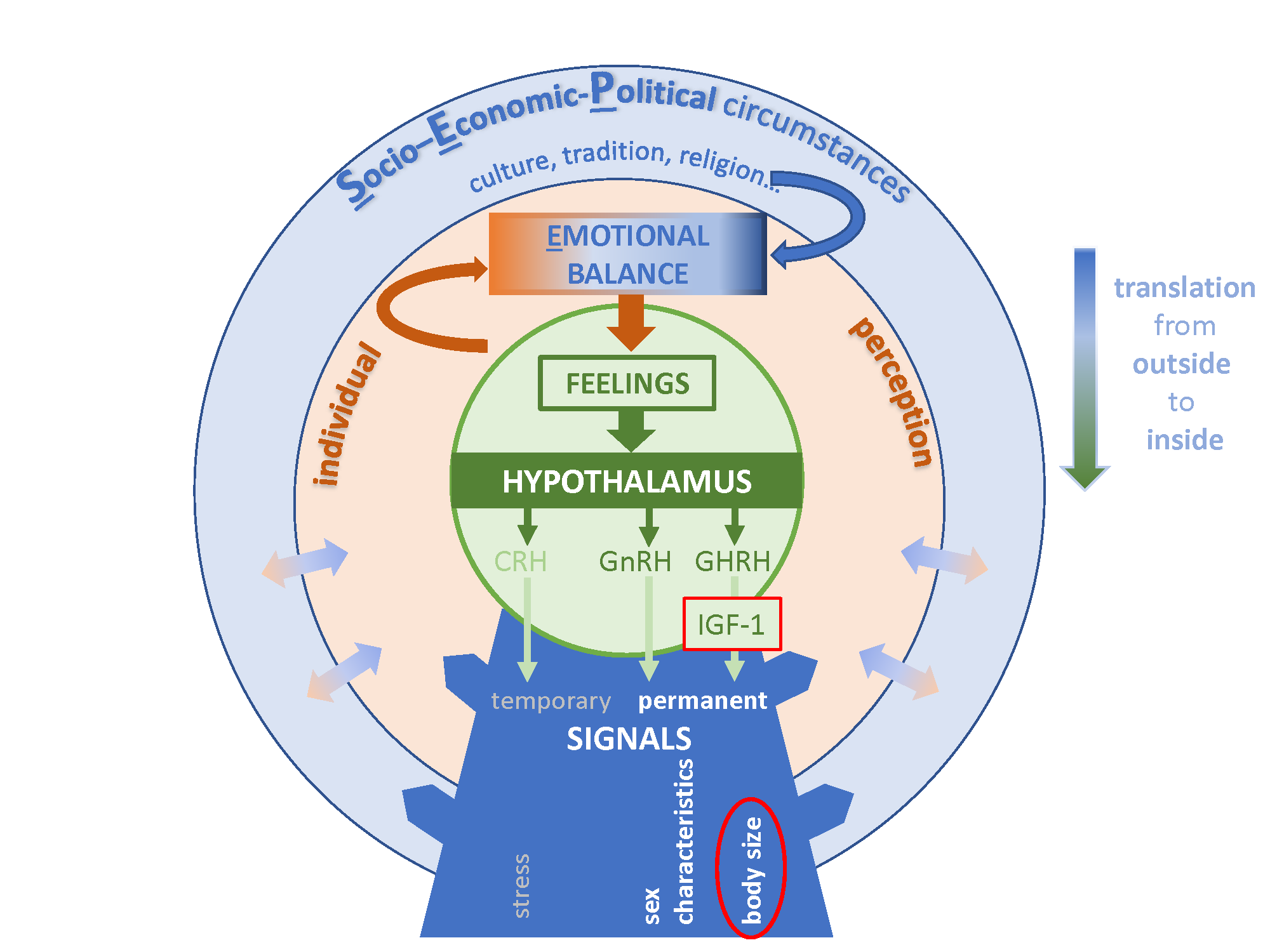
The concept of Socio-Economic-Political-Emotional (SEPE) influences on growth (Bogin 2021) describes growth as a mirror that signals the emotional balance and its adjustment between the socio-cultural exposome, i.e., the totality of the social, economic, and political environmental exposures from conception onward (Wild 2005; Buck Louis and Sundaram 2012; Wild 2012) (the outside) and an individual’s personal perception of this exposure and its translation into the metabolome (the inside). Love and affection versus repudiation, dominance versus subordination, aggression versus withdrawal, the entire variety of the socio-cultural part of the exposome corresponds to an analogous broad spectrum of emotions and feelings that can be translated from the primary neuronal information into hypothalamic neuropeptides. These peptides regulate the downstream endocrine circuits which, as regulators of the metabolome, then determine body size and sexual characteristics that ultimately serve as the appropriate physical signal of body size to be returned to the social community and to complete the socio-endocrine regulation of human growth (Hermanussen et al. 2022) (Figure 1).
Figure 1 The socio-endocrine regulation of human growth. Light blue color indicates the socio-cultural exposome, including the economic and political circumstances (the outside). Light brown color indicates the personal perception of the exposome and balances perceived socio-economic and political circumstances with personal attitudes, emotions, and feelings. The translator in this regulatory circuit, the hypothalamus (dark green), translates the primary neuronal information via neuropeptides into hormones as regulators of the metabolome (the inside) that ultimately create the permanent and temporary physical signals (dark blue) to be returned to the social community (light blue)
The strong conservation of this complex signaling pathway since more than 400 million years in the vertebrate line suggests substantial evolutionary relevance (Sherwood and Lovejoy 1989). This is strongly supported by recent considerations on self-organizing processes found in both random network systems and in the social networks of a variety of social vertebrates (Hermanussen et al. 2023).
Funding statement
There was no funding.
Acknowledgments
We appreciate stimulating discussions with Lawrence M. Schell and Barry Bogin.
References
Aßmann, C./Hermanussen, M. (2013). Modeling determinants of growth: evidence for a community-based target in height? Pediatric Research 74 (1), 88–95. https://doi.org/10.1038/pr.2013.50.
Bogin, B. (2021). Social-Economic-Political-Emotional (SEPE) factors regulate human growth. Human Biology and Public Health 1. https://doi.org/10.52905/hbph.v1.10.
Bogin, B./Varea, C./Hermanussen, M./Scheffler, C. (2018). Human life course biology: A centennial perspective of scholarship on the human pattern of physical growth and its place in human biocultural evolution. American journal of physical anthropology 165 (4), 834–854. https://doi.org/10.1002/ajpa.23357.
Buck Louis, G. M./Sundaram, R. (2012). Exposome: time for transformative research. Statistics in medicine 31 (22), 2569–2575. https://doi.org/10.1002/sim.5496.
Hermanussen, M./Aßmann, C./Scheffler, C. (2025). Avoiding "Too Tall" and "Too Short": The Effect of the Community on the Regulation of Body Height. American journal of human biology : the official journal of the Human Biology Council 37 (6), e70085. https://doi.org/10.1002/ajhb.70085.
Hermanussen, M./Dammhahn, M./Scheffler, C./Groth, D. (2023). Winner-loser effects improve social network efficiency between competitors with equal resource holding power. Scientific reports 13 (1), 14439. https://doi.org/10.1038/s41598-023-41225-y.
Hermanussen, M./Erofeev, S./Scheffler, C. (2022). The socio-endocrine regulation of human growth. Acta paediatrica (Oslo, Norway : 1992) 111 (11), 2077–2081. https://doi.org/10.1111/apa.16504.
Hermanussen, M./Scheffler, C. (2016). Stature signals status: The association of stature, status and perceived dominance - a thought experiment. Anthropologischer Anzeiger; Bericht uber die biologisch-anthropologische Literatur 73 (4), 265–274. https://doi.org/10.1127/anthranz/2016/0698.
Koops, K./Schuppli, C./van Schaik, C. P. (2018). Cultural primatology. In: W. Trevathan/M. Cartmill/D. Dufour et al. (Eds.). The International Encyclopedia of Biological Anthropology. Wiley, 1–7.
Scheffler, C./Groth, D./Hermanussen, M. (2025). Political Liberation, Hope, and Social Competition Are the Motor of Secular Trends in Height. American journal of human biology : the official journal of the Human Biology Council 37 (7), e70095. https://doi.org/10.1002/ajhb.70095.
Sherwood, N. M./Lovejoy, D. A. (1989). The origin of the mammalian form of GnRH in primitive fishes. Fish physiology and biochemistry 7 (1-6), 85–93. https://doi.org/10.1007/BF00004693.
Tanner, J. M. (1978). Foetus into man. Physical growth from conception to maturity. Cambridge, Mass., Harvard Univ. Press.
Wild, C. P. (2005). Complementing the genome with an "exposome": the outstanding challenge of environmental exposure measurement in molecular epidemiology. Cancer epidemiology, biomarkers & prevention : a publication of the American Association for Cancer Research, cosponsored by the American Society of Preventive Oncology 14 (8), 1847–1850. https://doi.org/10.1158/1055-9965.EPI-05-0456.
 ✉
✉